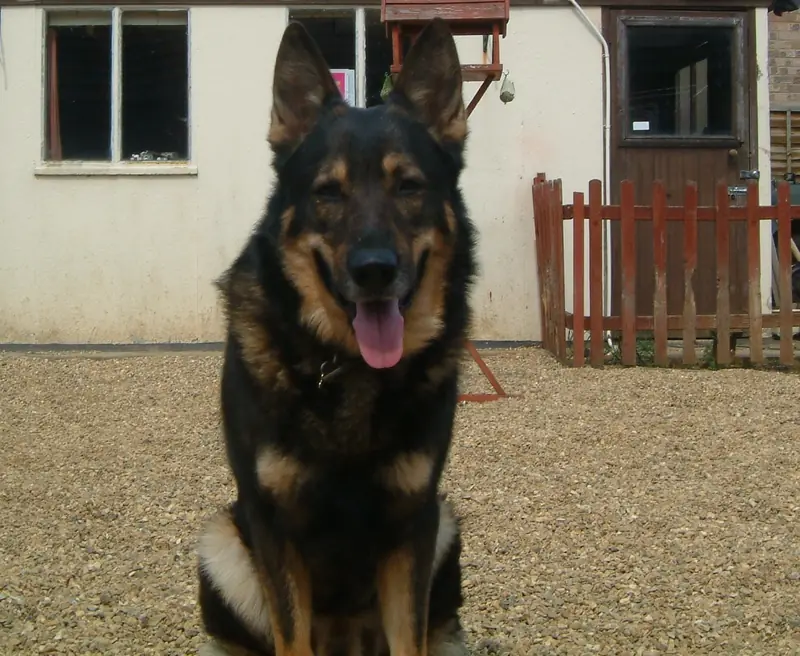
German Shepherd history, standard and clubs
From a Frankfurt club meeting in 1899 to two registries in South Africa.
From German herding dogs to a working breed.
The breed's founding club, the Verein für Deutsche Schäferhunde (SV), was set up at a general meeting in Frankfurt on 20 September 1899, on the suggestions of A. Meyer and Max von Stephanitz, and it remains responsible for the standard. The breed was developed from German herding dogs into a working dog for herding, guarding and service.
A 2009 South African study notes that it descends from a single founding sire and has been extensively inbred. The FCI accepted it on a definitive basis on 1 January 1955, with two coat varieties.[1][2][3]

The German Shepherd in South Africa
Key dates from the SV, the FCI, KUSA and South African research.
- 120 September 1899The SV is founded in Frankfurt and becomes responsible for the breed standard.[1]
- 21 January 1955The FCI accepts the breed on a definitive basis, with two coats.[3]
- 31984The German Shepherd Dog Federation of South Africa becomes active; it is a member of the WUSV and the SV.[4]
- 42009A University of Cape Town study finds South African and German-bred lines equally diverse, as imports keep them close.[2]
- 52025KUSA registers 310 German Shepherds: 243 stock coat and 67 long coat.[5]

What the standard covers, in plain words.
KUSA publishes the FCI standard, No. 166, with its most recent changes effective 1 February 2021. It covers the SV's history, general appearance, proportions, character, head, neck, body, tail, limbs, gait, skin, the two coats, colours, size and weight, and faults.
The recognised colours are black with reddish-brown, brown, yellow or light grey markings; solid black; and grey with darker shading, a black saddle and a mask. Small white chest marks are permitted but not wanted, the nose must be black, and white is not allowed. We summarise the standard and never reproduce it.[6][1]
The KUSA standard (PDF)
Breed assessments and breed surveys.
KUSA's German Shepherd Dog Liaison Council runs breed assessments, which check conformation, movement, steadiness to gunshot, disposition and mental value, from 12 months of age.
The German Shepherd Dog Federation follows the SV's breed-survey system and runs IGP, the breed's international working sport. A survey or assessment result is extra evidence about a breeding dog's body and character, so ask for it.[7][4]
Two coats, two registers
KUSA registers the stock coat and the long coat as separate varieties of one breed.
Stock coat (Stockhaar)
- Dense, harsh and close-lying, with an undercoat
- 243 KUSA registrations in 2025
- The more common coat on KUSA's register
Long coat (Langstockhaar)
- Long and soft, with tufts on the ears and legs and a bushy tail, over an undercoat
- Grew from 7 KUSA registrations in 2016 to 67 in 2025
- A recognised variety, not a rarity
- KUSA can reclassify a dog's coat type by a judge's assessment or a DNA test, because a long coat can appear in a stock-coat litter
Breeds to compare
The comparison people make most often, and a size myth worth clearing up.
German Shepherd or Belgian Malinois
- The German Shepherd is a herding breed in FCI Group 1, bred for work
- A German Shepherd dog stands 60 to 65 cm and weighs 30 to 40 kg
- Read the Malinois guide's own figures before you compare the two
Clubs, registries and rescue in South Africa
Named as found on 27 November 2026, with public websites only where we could confirm one. No endorsement is claimed.
The registries
- The Kennel Union of Southern Africa (KUSA), which registers both coats: kusa.co.za
- KUSA's German Shepherd Dog Liaison Council, reached through KUSA; we found no separate website
- The German Shepherd Dog Federation of South Africa, active since 1984 and a member of the WUSV and the SV; we could not confirm its website
Rescue
- We have not confirmed a German Shepherd rescue, so we name none
- Ask your local SPCA about adult German Shepherds that need homes
- An adult whose temperament is already known can suit a family that would rather skip puppyhood
Read the FCI standard before any advert: it sets out the size, coats and colours a German Shepherd should have. The FCI's page links it free.
The FCI breed pageSources for this page
- FCI, standard no. 166, German Shepherd Dog (English, St-FCI n°166 / 23.12.2010; official valid standard published 11.08.2010). Read 27 Nov 2026.
- Coutts, N.J. and Harley, E.H. (2009), "Comparative population genetics of the German shepherd dog in South Africa", South African Journal of Science 105(3-4): 132–135 (abstract on OpenUCT). Read 27 Nov 2026.
- FCI, "German Shepherd Dog (166)" breed page. Read 27 Nov 2026.
- Sedibeng Ster / The Citizen (26 Jun 2025), "German Shepherd Nationals bring world-class dog sport to Meyerton" (GSDFSA, active since 1984, WUSV and SV member; IGP). Read 27 Nov 2026.
- KUSA, "2025 KUSA Registry Statistics, with 10 year history", 1 Jan to 31 Dec 2025 (Stockhaar 213 in 2016, 243 in 2025; Langstockhaar 7 in 2016, 67 in 2025). Read 27 Nov 2026.
- KUSA, breed standard "German Shepherd Dog (2 Varieties) - FCI [02-2021]" (LangStockhaar, Stockhaar), Working Group, most recent changes effective 1 Feb 2021. Read 27 Nov 2026.
- KUSA, "Schedule 5F (9.1.2) Regulations for German Shepherd Dog Breed Assessment", effective 1 Sep 2024. Read 27 Nov 2026.
- KUSA, "Guidelines for reclassification of German Shepherd Dog coat types" (Word document). Read 27 Nov 2026.
- O'Neill, D.G., Coulson, N.R., Church, D.B. and Brodbelt, D.C. (2017), "Demography and disorders of German Shepherd Dogs under primary veterinary care in the UK", Canine Genetics and Epidemiology (PMID 28770095; abstract on Europe PMC). Read 27 Nov 2026.
Written from the sources above for Premier Pets. Last reviewed 27 November 2026. Spot something out of date? Email sales@premierpets.co.za.